

We All Know ALICE
Working does not always mean financially secure
ALICE stands for Asset Limited, Income Constrained, Employed. These households often include the workers who keep communities operating: child-care employees, home-health aides, cashiers, cooks, administrative professionals, drivers, hospitality workers, retail employees, and many others.
Their income is above the official poverty level, yet it remains below the amount required to cover housing, child care, food, transportation, health care, technology, taxes, and other basic household expenses in their county.
The State of ALICE in Texas
2026 report · 2024 household data
1,523,679 Texas households were below the Federal Poverty Level.
3,085,614 households earned above poverty but below the cost of basics.
Poverty-level and ALICE households combined—roughly two out of every five.
Poverty Level vs. Cost of Basics
The official poverty measure does not reflect local living costs
Important: These are statewide comparisons from the 2026 report. Household costs and the ALICE Threshold vary by county and household composition.
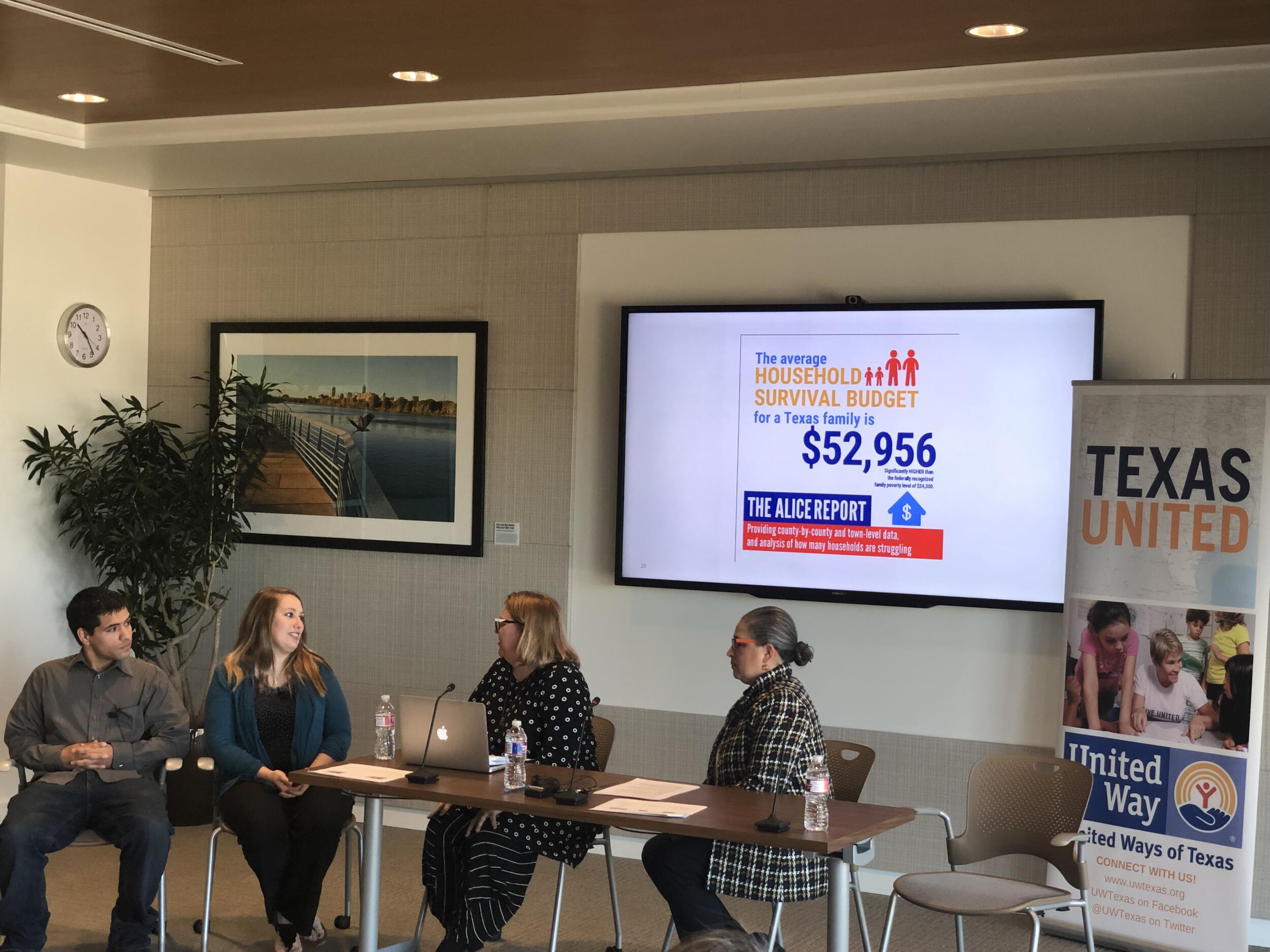
Household Survival Budget
The minimum costs required to live and work
The Survival Budget is intentionally modest. It does not represent a comfortable lifestyle and does not include savings for college, retirement, homeownership, or most long-term goals.
Central Texas Data
Explore the counties and communities UWCT serves
The current county tool includes county, ZIP-code, subdivision, and place-level information. Select Bell, Coryell, Hamilton, Lampasas, Milam, Mills, San Saba, or another Texas county to examine local conditions.
COUNTY & PLACE DATA
Where is hardship concentrated?
Review household counts, poverty and ALICE rates, demographic patterns, labor information, cost estimates, ZIP codes, and communities within a selected county.
OPEN TEXAS COUNTY REPORTS →HOUSEHOLD-SPECIFIC TOOL
Is this household below the threshold?
Select a location, household income, adults, older adults, infants, preschoolers, and school-age children to compare income with local household costs.
USE THE INCOME STATUS TOOL →Go Deeper With the Data
Tools for families, employers, nonprofits, and leaders
State findings, financial-hardship trends, cost comparisons, demographics, labor-force information, and county analysis.
DOWNLOAD REPORT →The Texas CLIFF Dashboard helps users explore career pathways, income changes, family circumstances, and the potential loss of public benefits as earnings rise.
OPEN CLIFF DASHBOARD →Explore financial hardship by congressional and state legislative district to support informed public policy and advocacy.
EXPLORE DISTRICT DATA →Review how household budgets, the ALICE Threshold, county adjustments, cost sources, taxes, contingency expenses, and other measures are calculated.
REVIEW THE METHODOLOGY →Why ALICE Matters to Central Texas
Financial hardship affects the entire community
When wages do not cover the cost of basics, households make difficult tradeoffs: rent or child care, medicine or groceries, transportation or utilities. These choices affect health, school attendance, employee retention, productivity, housing stability, and demand for emergency services.
ALICE data gives Central Texas a shared way to understand those pressures and design strategies around the actual cost of living—not poverty statistics alone.
Turning Data Into Action
How UWCT supports working households
2-1-1 Resource Navigation
Connects residents with information about food, housing, utilities, health care, transportation, benefits, child care, employment, counseling, and other essential resources.
EXPLORE 2-1-1 →VITA Free Tax Preparation
Helps eligible households avoid preparation fees and receive the tax refunds and credits for which they qualify.
EXPLORE VITA →Community Investment
Supports trusted nonprofit partners working in health, education, financial stability, food access, housing, family safety, youth development, and basic needs.
VIEW COMMUNITY PARTNERS →Convening and Advocacy
Brings employers, nonprofits, schools, health systems, public agencies, donors, and residents together around data-informed community solutions.
CONTACT UWCT →Use ALICE in Your Work
Start with the question your organization needs to answer
Examine whether wages, schedules, child-care support, health benefits, transportation, paid leave, and emergency assistance help employees remain stable and retained.
Use county and household data to define needs, set realistic eligibility rules, identify service gaps, build collaborations, and explain investment priorities.
Compare poverty data with local survival costs when considering housing, transportation, child care, workforce, health, education, and economic-development decisions.
Use the budget and income tools to understand household pressures, explore career pathways, and locate community resources without treating financial hardship as personal failure.
Frequently Asked Questions
Understanding ALICE correctly
Is ALICE another word for poverty?
No. ALICE households earn above the Federal Poverty Level but less than the local cost of basic household necessities. “Below the ALICE Threshold” includes both households in poverty and ALICE households.
Why does the 2026 report use 2024 data?
Large household and cost datasets require collection, validation, analysis, and publication time. The current 2026 report presents 2024 point-in-time data and should be labeled that way when quoted.
Is the Household Survival Budget a recommended household budget?
It is a research estimate of the minimum cost of living and working for specific household types and locations. It does not represent a comfortable standard of living and excludes many savings and long-term goals.
Does the Texas average describe every Central Texas household?
No. Costs differ by county, household composition, age, child-care needs, health circumstances, taxes, and other factors. Use the county and household tools for a more relevant estimate.
Can ALICE data determine eligibility for a program?
Not automatically. ALICE is a research framework. Individual programs establish their own eligibility rules, documentation requirements, service areas, and available resources.
Where can I ask technical questions about Texas ALICE data?
United for ALICE Texas lists aliceintexas@uwtexas.org for Texas report questions. Contact UWCT for local presentations, partnerships, or community discussions.
Where should a household start when it needs immediate help?
Call 2-1-1 for information about available food, housing, utilities, health, transportation, child care, benefits, employment, and other resources. Availability and eligibility vary.
Better data leads to better community decisions
Explore current Texas and county findings, bring ALICE into workplace and community conversations, or connect a household with immediate resources.
EXPLORE COUNTY DATA CALL 2-1-1 CONTACT UWCT